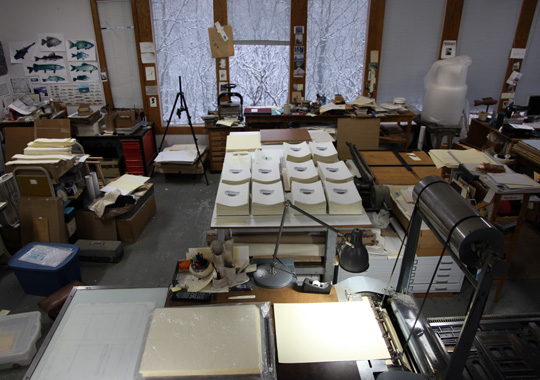
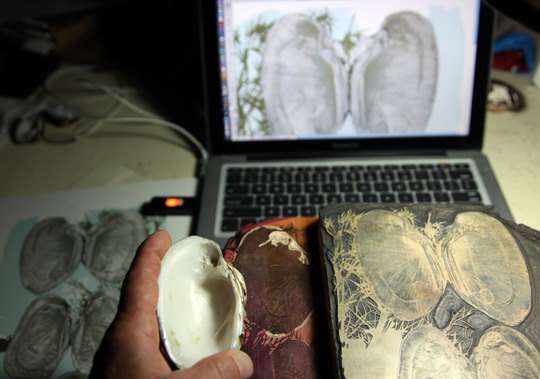
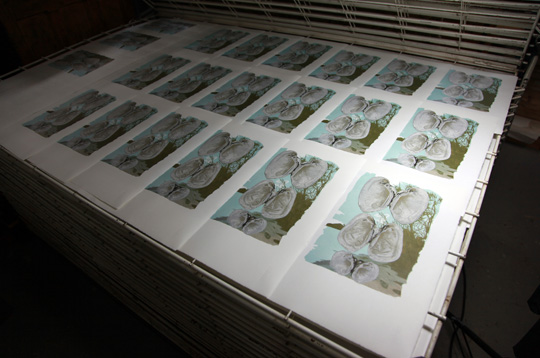
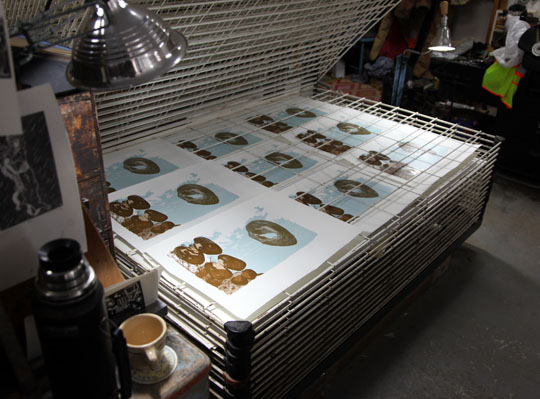
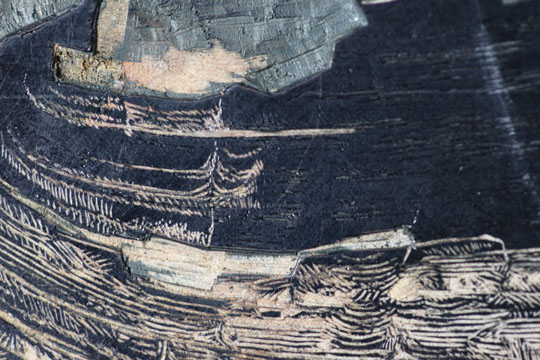
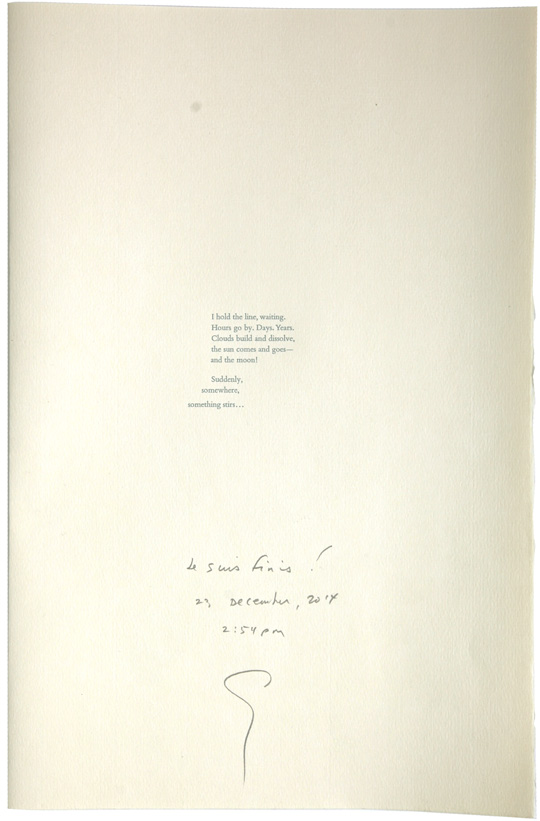
From the time of my last post, until December 23rd, I printed. On December 27 I drove.
Stockholm
I have just returned from delivering the printed sheets of Lac Des Pleurs to binder Craig Jensen, a 19-hour drive from Stockholm, Wisconsin, to San Marcos, Texas. The books were entombed in four bubble wrap cocoons slid snugly into four 18 gallon Rubbermaid Roughneck plastic totes that were placed in the bed of a 2004 Chevy Silverado pickup truck. Each cocoon was carefully labeled with Craig’s address and telephone number. Should a collision cause the totes to get airborne, the cocoons still had a chance.
San Marcos
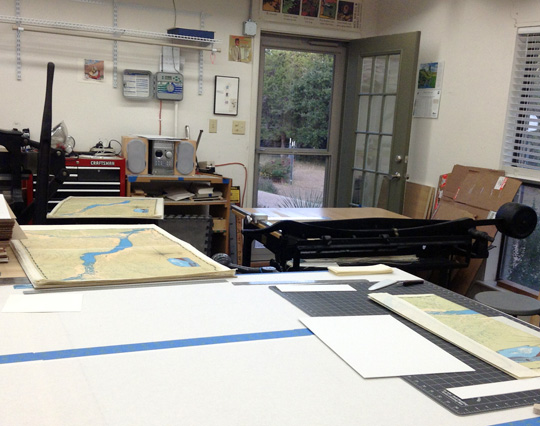
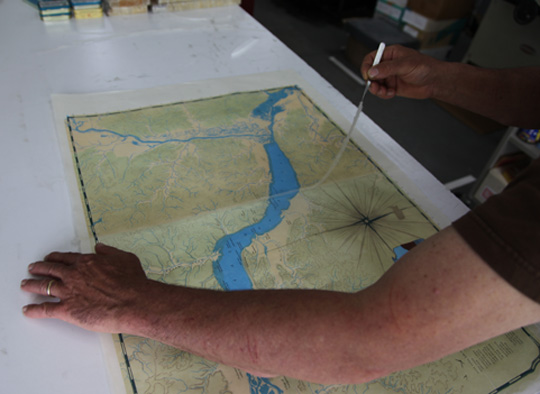
The maps were delivered unfolded so final adjustments might still be made. We were able to find a way of trimming the head of the book without slicing the top fold of the map, making for a better book. Craig set me up in his bindery folding. I finished folding and drove back to Wisconsin with Lac Des Pleursin the rear view mirror.
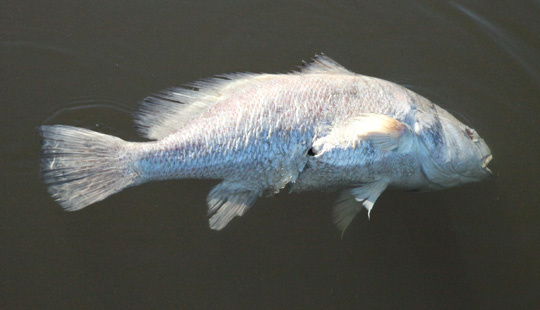
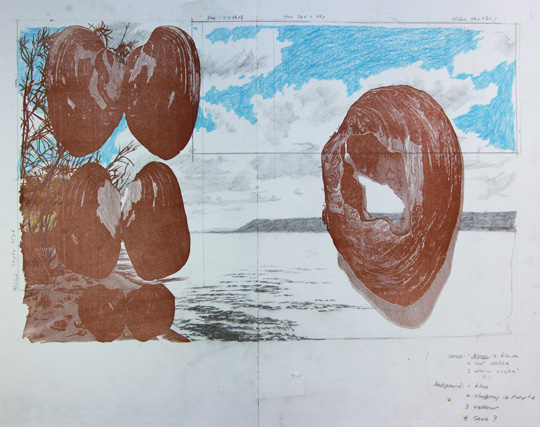
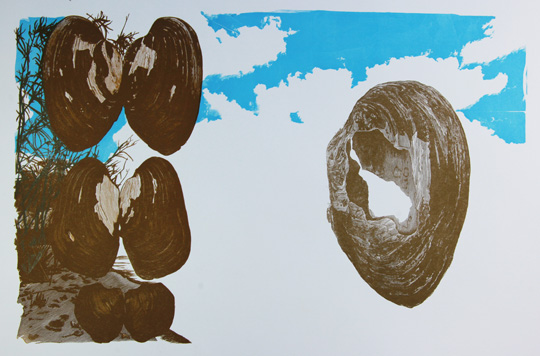
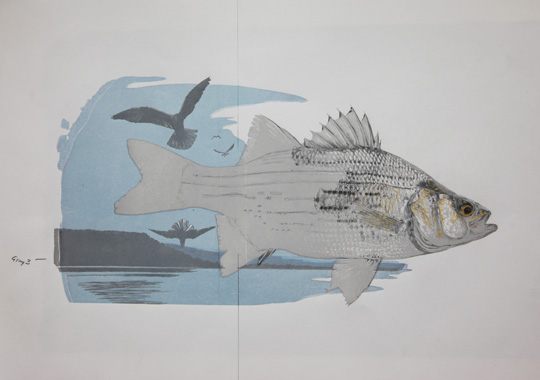
I am printing a freshwater drum, the final image of the book. The key block, based on a photograph of a living specimen, was cut during the winter of 2008. Since then the book has evolved, and a caption has emerged for the image that is a poem describing a dead drum. I have saved this image for last, this drum, to allow time to think about the living fish, and the dead one.
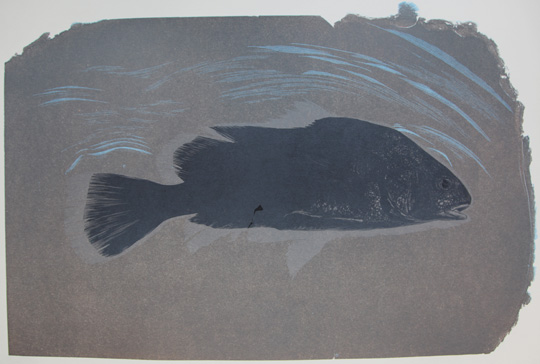
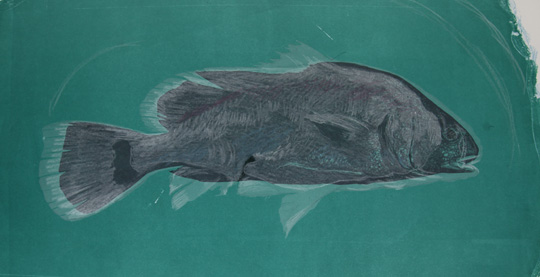
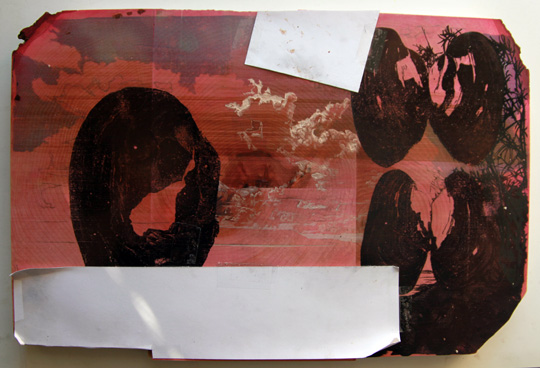
The first press run has been printed from from a large background block representing the water the fish is swimming in, or floating on. Then the key block of the living drum was printed in black. A reduction cut of the background block was printed next in brown, over the water, and a second key block (of the dead drum) was printed, in opaque white, over the key block of the living drum. That is where things stand.
where things stand
Of course much proofing from the blocks was done before the book paper was cut and printing of the actual pages began: trying various colors, and sequences, and then drawing onto the proofs to get some idea which way to go. I showed what I thought was a promising direction to Anicka and she said, “It’s not working, Dad.”
a promising direction
Anicka is gone now, back at school, and I have no choice but to push on. The challenge is to turn this living fish into a dead one, while somehow keeping it alive. A ghost.
As the images for this book have emerged, the process–the method and vision involved in making them–has evolved. During the process of printing, it seems to me now, the image is in a state of constant revision, not unlike a poem, or a painting. With the emergence of each image confidence grows, to the point that I can now continue printing, though the vision remains unclear.
I feel I have crossed into a highland, a technical plateau with a view that is both unexpected and sublime. As I look out over this pool of images, I could not have foreseen what I see. This is a place I could not know until I came here, and I will leave when the drum is done. The memory of this place will stay with me, but once I climb down, I can’t return. I am gone.
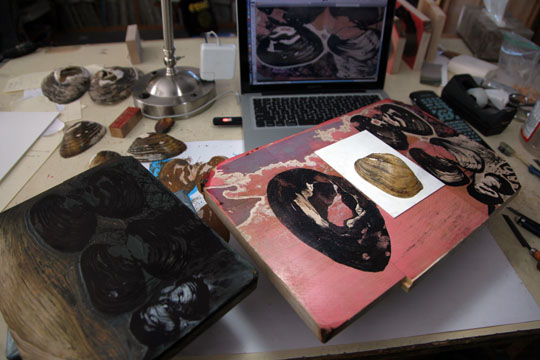
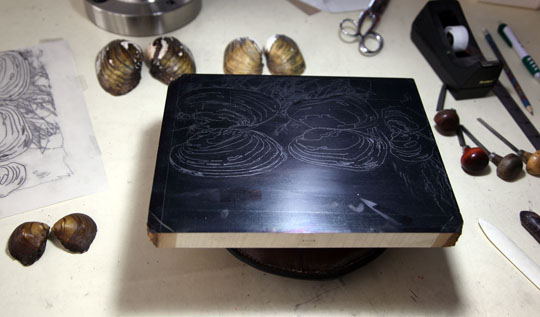
The basic orientation problem when it comes to printing in relief is, of course, image reversal–the inked impression of a surface is its mirror image. In a complex image involving multiple blocks and numerous over-printings of color, things get complicated rather quickly. One early decision that proved to be a good one was to make the mussel blocks the same orientation as the specimens themselves. This made studying the shells while engraving them much easier. As a result I had to scan images proofs as I went along, and flip them horizontally in Photoshop so they could be studied in the same orientation as the blocks (and the shells themselves) but the ability to study the actual specimen while engraving was worth the trouble. The printed image is the reversal of the animal’s true orientation, but I can live with that.
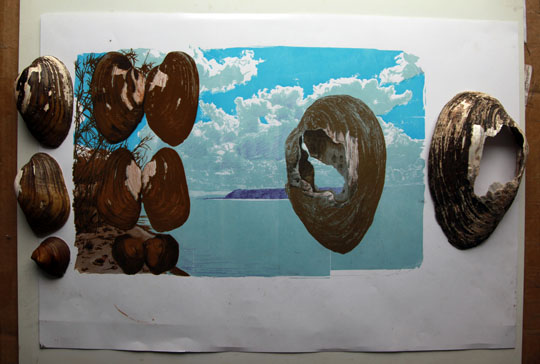
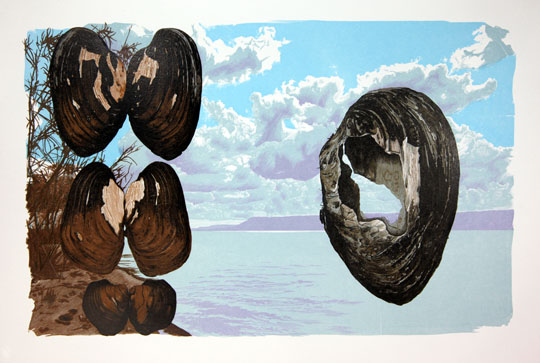
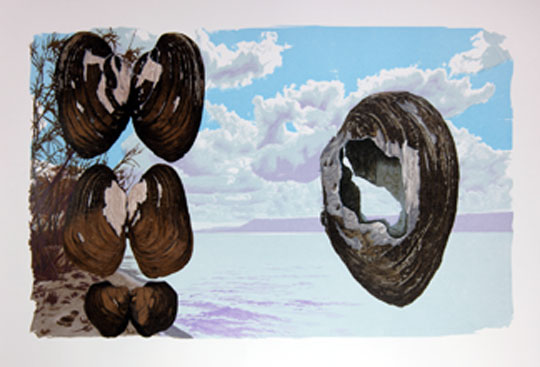
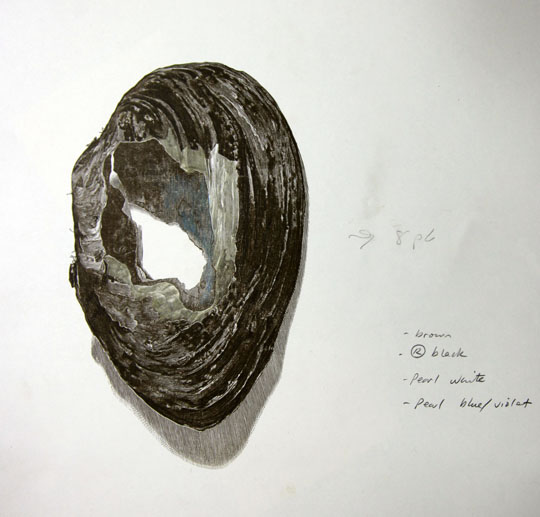
On the afternoon of June 21 the final impression from the final block of the upstream side of the mussel image was taken, more than 5 months since work on the mussels began. Though composed, as you have seen, of more than one image, I see it as a single unit: the upstream, inside surfaces of the three pairs of mussel shells on the recto; the downstream, outside surfaces of the three on the verso; and the beautiful fractured Pyganodon grandis filling the sky over the Lac Des Pleurs. The recto, upstream image is purposely more monotone and less dramatic (by far) than the recto downstream image in order to enhance the impact of tuning the page–I am, remember, printing a book!
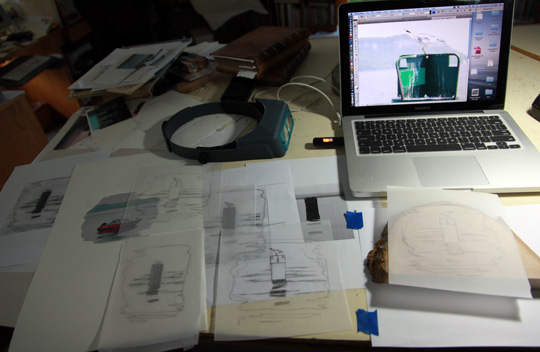
Now back to the drawing board. I will be working on the tail piece image–a gull on a buoy–while I ready the blocks for the final large image left to print:
On the second day of February, into the clouds…On the seventh day…On the tenth day…On the twelve, drawing up the eventual reduction of the cloud block for purple…On February Thirteenth a little solution…On the Fourteenth printing clouds…On the Twenty-sixth reduction of the key block begins…Still cutting on March Third:the shell& the block (as I see it).Still cutting on March Fourth…On the SeventhI printed the black…On the Thirteenth purple (from a reduction cut of the cloud block)…On the Twentieth another purple (from the cloud block once more)…
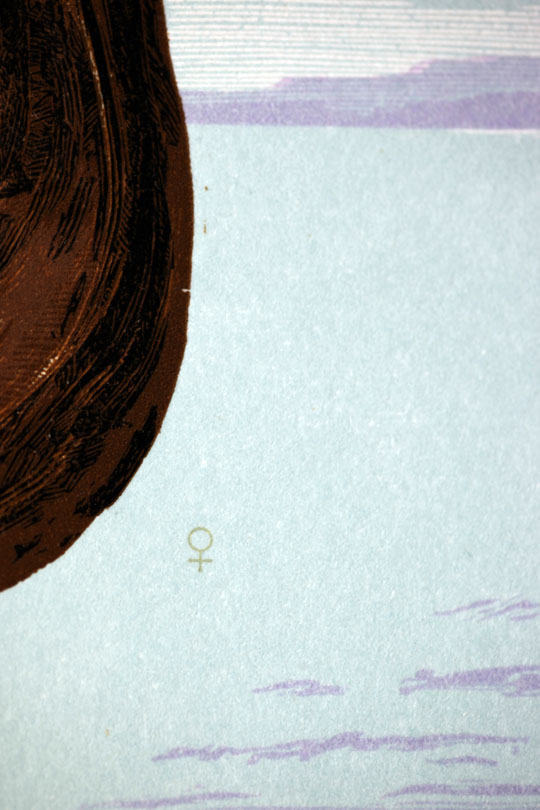
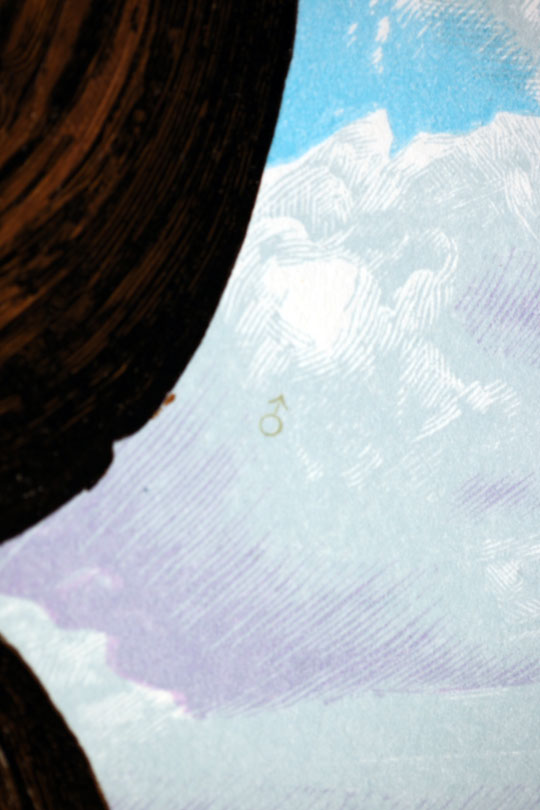
On March Twenty-first the 11 point female symbol was printed,
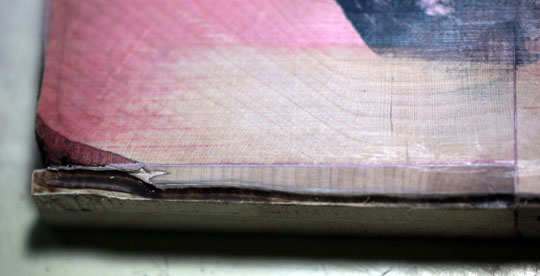
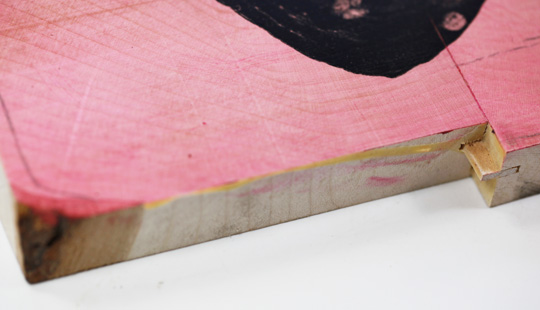
A piece of this block has come up short. I had hoped to continue the background of the image into the corner. One could re-think the image and taper it away from the problem, or perhaps manufacture a piece of wood to fill the space. The fashioning a piece of wood square with the larger block and precisely the same height presents problems. Something to think about…
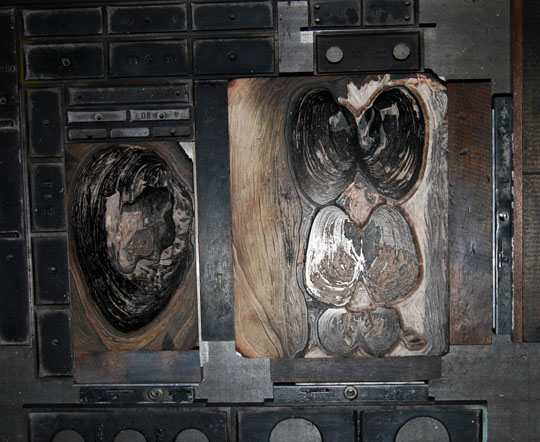
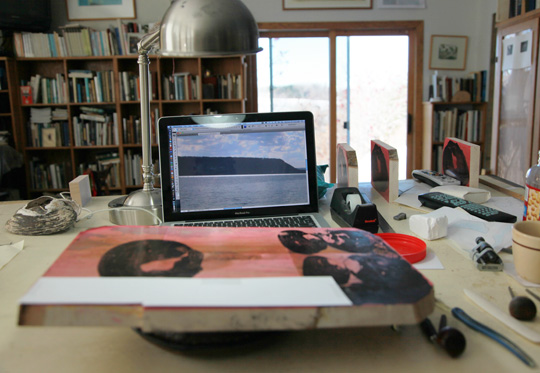
A drawn-upon proof of the two key blocks. The corner in question is the lower right. You can just make out the drawn line of the original idea for the boundary of the water.
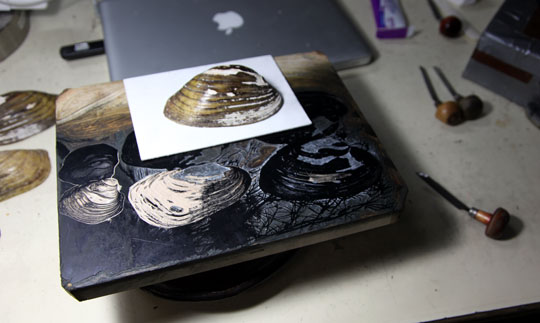
There are the two mussel colors already printed. The shells on the left have been printed twice with a reduction cut between printings. The shell on the right is older and lacks the depth of color that the younger shells possess, so it was spared the reduction cut. The blue sky block is cut and proofed, but has yet to be printed.
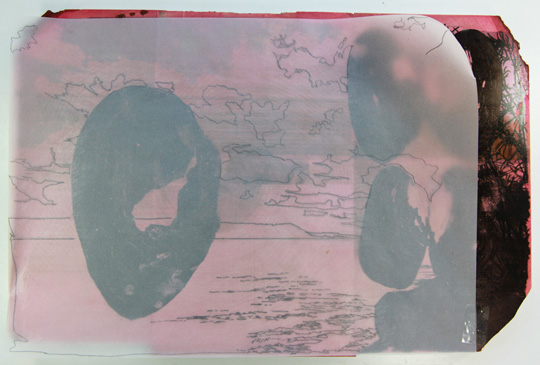
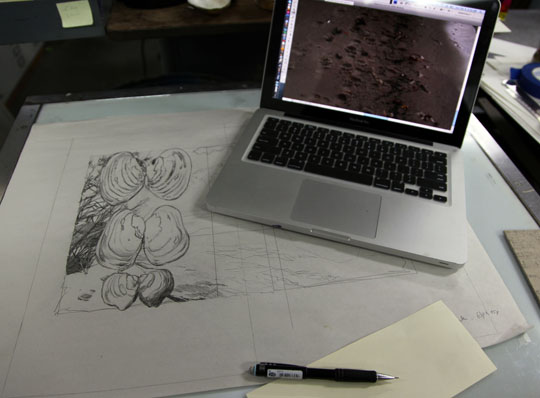
The background block with the two key blocks and the sky block proofed onto it, and with tracing vellum in place for drawn lines to be burnished onto the block. The problem corner is on the lower left, just visible through the vellum.
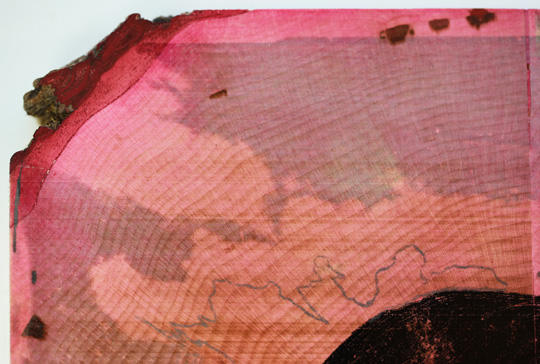
You can see the printed impression of the blue block, some graphite line burnished off the tracing vellum, and the top edge of one of the key blocks: all essential reference for the cutting of the background block.
Meanwhile the polar vortex has plunged again: perfect engraving weather. I’ve begun cutting the background block with plenty of time to consider what to do about my little problem…
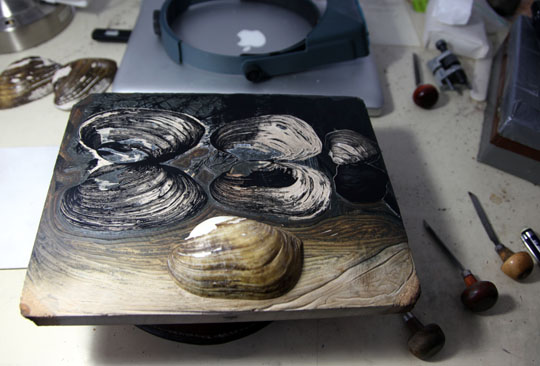
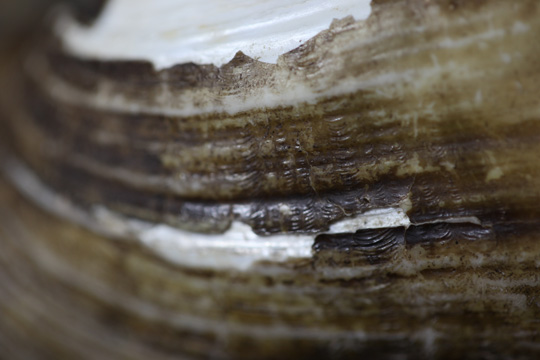
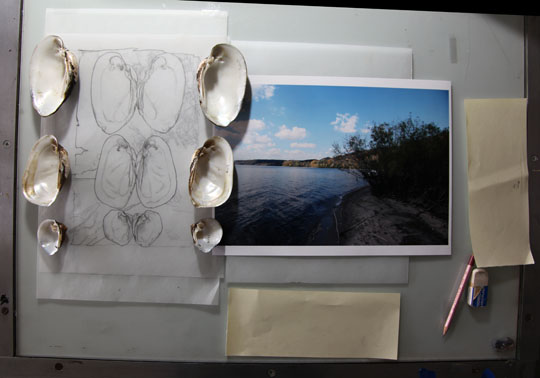
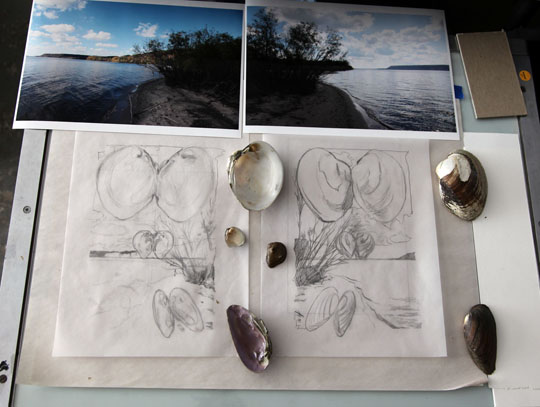
The idea was to print engravings of three species of mussels with the inside of the shells on the recto of a sheet, and the outside of the shells on the verso of the same sheet. In the background would be two views of the river from the same spot: one looking upstream, and the other down. But before I could begin engraving, I needed to meet with biologist Mike Davis for verification of the identities of the shells. He was unavailable for a few weeks, so I decided to go ahead and engrave a fractured Giant Floater (Pyganodon grandis), whose identity was certain.
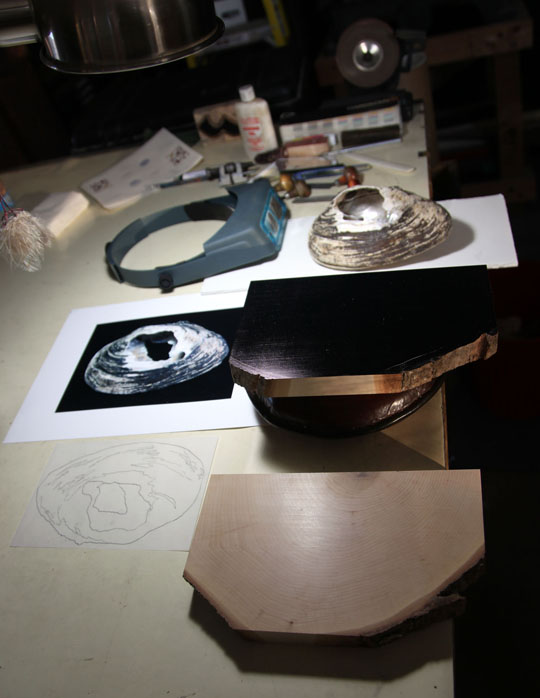
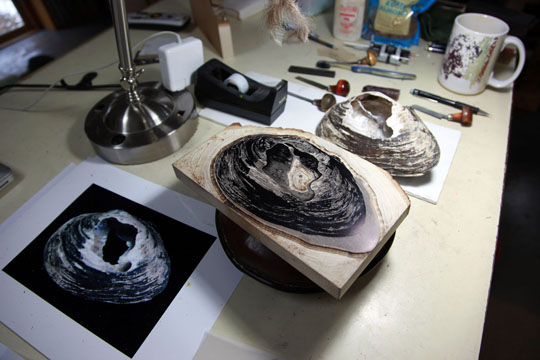
Engraving the Giant Floater key block began on November 14…and ended on December 10.A proof of the key block, drawn on with colored pencils in anticipation of color blocks.
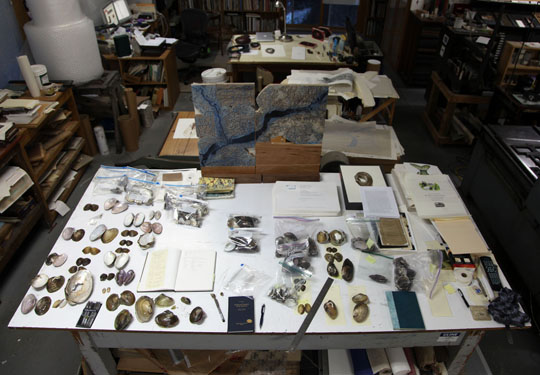
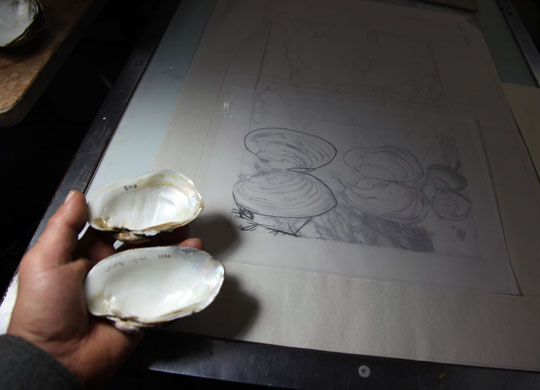
I sorted through the 138 mussel specimens collected and selected about half of them for identity verification. Biologist Davis noted that the two Lake Pepin Mucket specimens represented both sexes. I asked him how he could tell the difference, and he pointed out the bulge in the female shell to accommodate her larvae. This was too interesting to pass up, so I decided to revise the image.
The top shell is from the female, and the bottom from the male. The revised drawing is underway in the background.
Adding my footprint (lower left) to the image.The drawing has been transferred to the block. Back to engraving for awhile…
At first
along the shoreline
another retired tire
another lost sole,
and this wet conduit flows
with the smallest fish
swimming through–
one little heart at a time
among billions–
some turn as I approach
some leap clear.
…
And now
in the distance
a broken line of white,
like bubbles floating upstream:
a slow procession
of white pelicans
in single file
along Point-No-Point.
All sound is suddenly far away
while the sun pulls down the sky
and everything with it
except a big fish
that jumps.
…
And now
the philharmonic trill of legs
rubbing in the dark
while a coyote makes tracks
along the nervous sand
where the moon always finds us
less than full.
…
At dawn one pelican moves
along the distant pointless shore
but around the bend
about to come into view
more pelicans!
A castle at dawn.Engraving the final block along Point-No-Point.
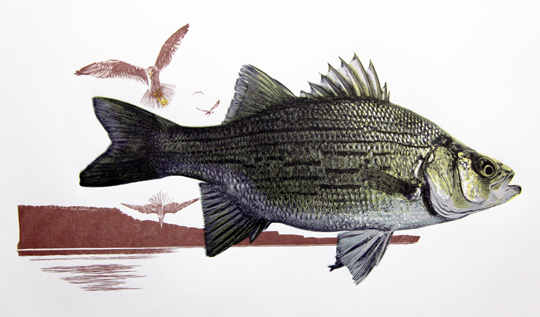
Since the last post three more White Bass colors have been printed. Here the cutting of a separate yellow block is underway.
Each of the three reduction cuttings of the key block were proofed onto the yellow block for reference.
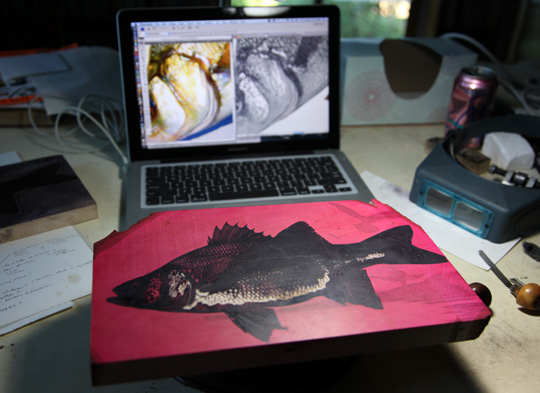
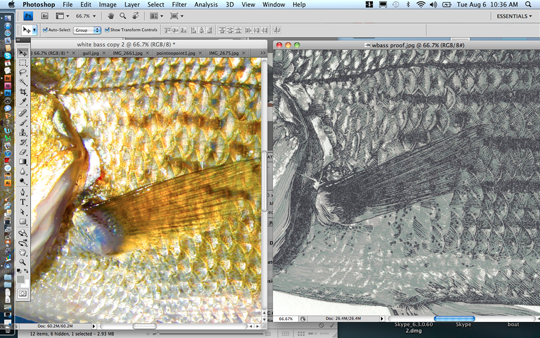
On the left the yellow pigmentation of the fish has been exaggerated in Photoshop. On the right a scan of the printed fish thus far helps to keep orientated while working on the yellow block.
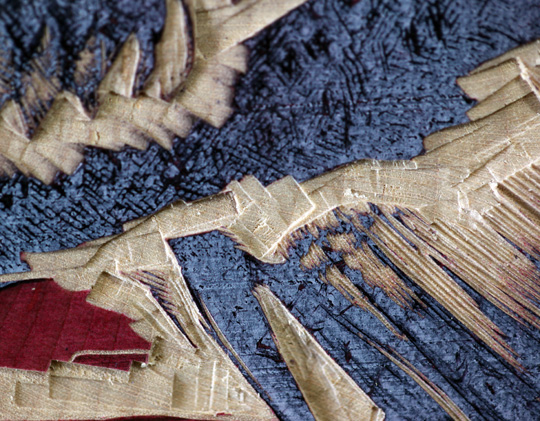
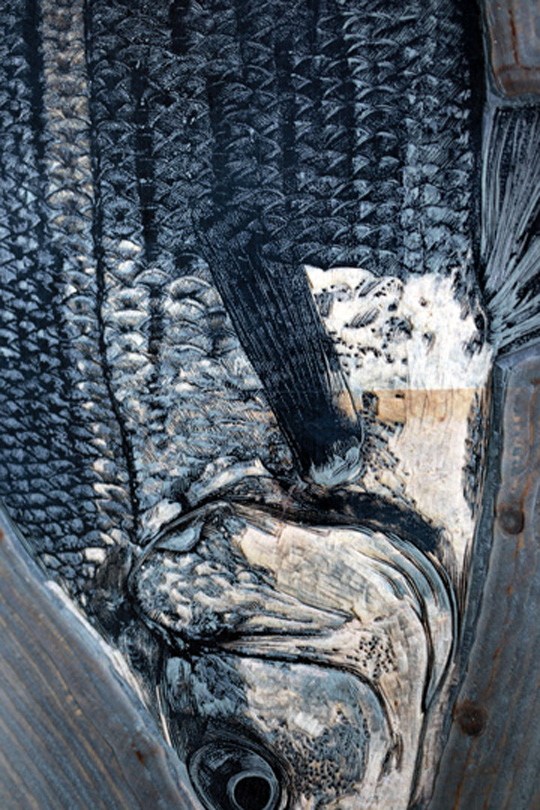
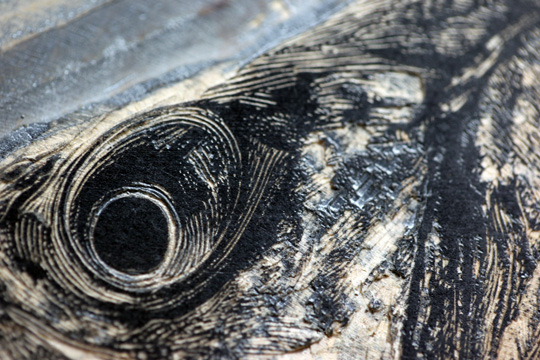
Two basic steps are involved in the cutting of the block: first the lines are engraved; then enough wood is hand-cleared from around the areas to be printed to allow room for the mechanical router bit to pass through.
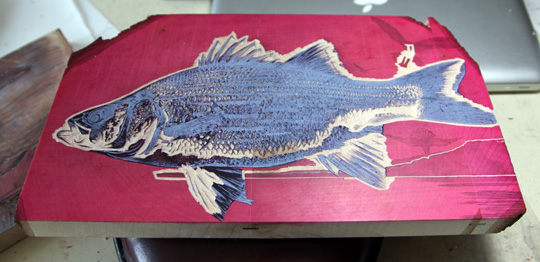
Hand-clearing is complete and the block is ready for the router.
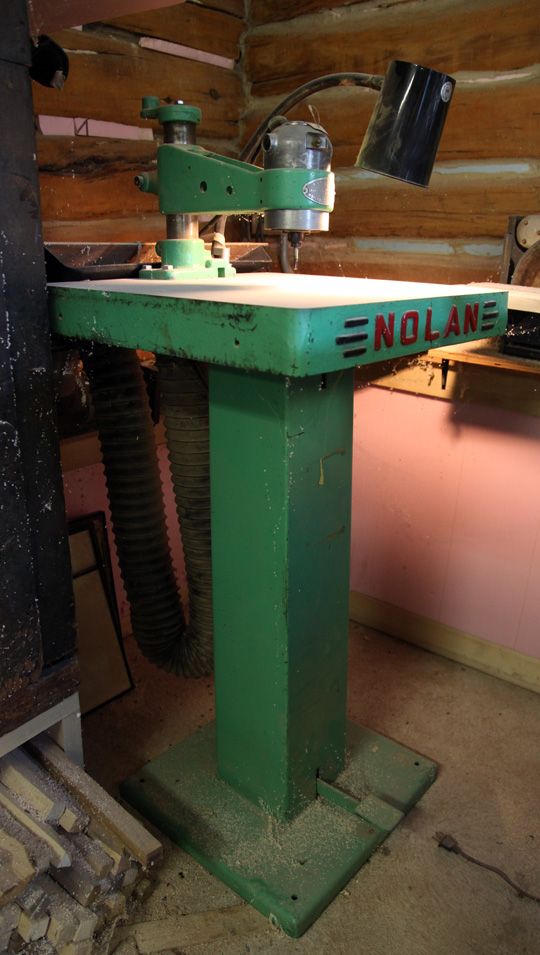
The Nolan Router
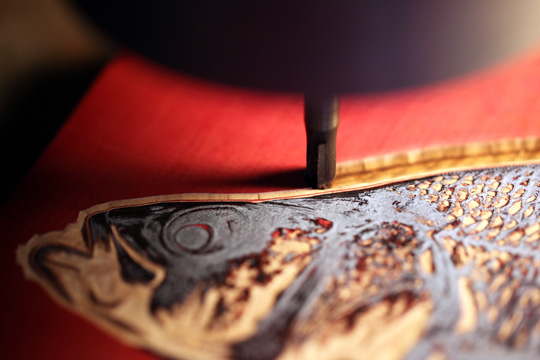
The Nolan routing.
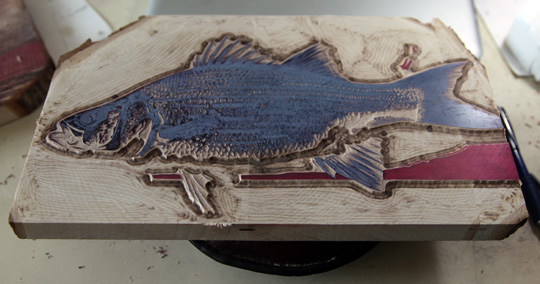
The routing complete.
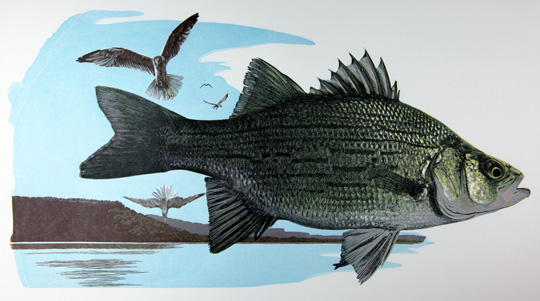
The yellow is printed–one of five colors so far–with the possibly four more to follow.
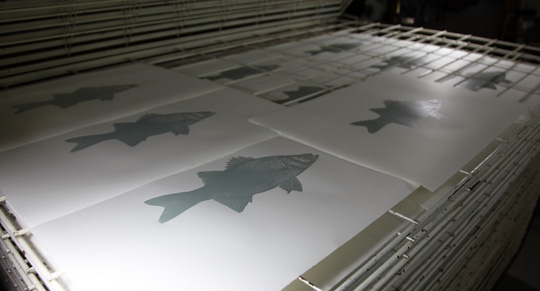
In two months I’ve managed to print two colors of the White Bass, with a reduction cut of the key block in between. The humidity has made registration a challenge, as either the paper or the block has expanded. It’s difficult to tell what exactly is going on, but even a week of air conditioning in the shop hasn’t helped much.
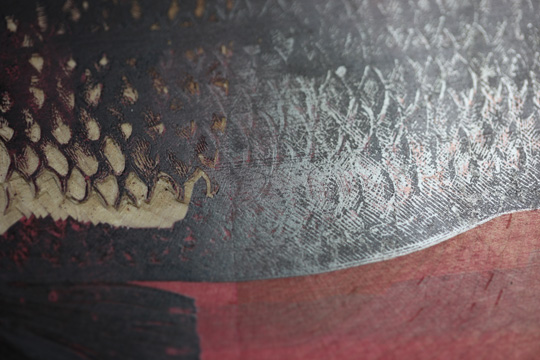
The subtle cutting of the block has made regular cleaning essential in order to hold the detail. The block is cleaned with type wash and a type brush after every eight or so impressions. Here the block is freshly cleaned.
Following completion of the second press run the fish was inked up with black ink, which was allowed to dry, and now I’m engaged in another reduction cut.
Each scale is studied on the computer screen, and it’s portrait engraved, now for the third time. I’m getting to know this fish.
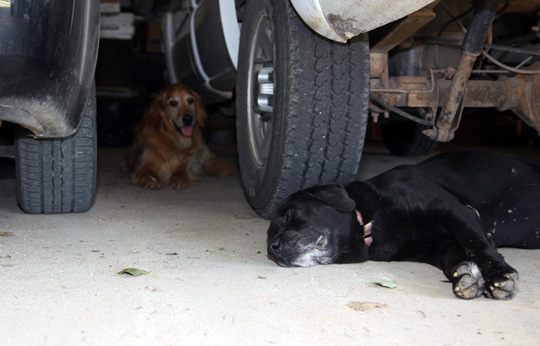
Meanwhile the dogs spend most of the day prone or panting on the cool cement of the garage floor.
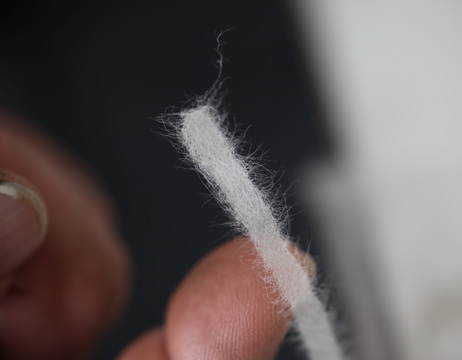
The final step of map-making is underway–a butt joint secured on both sides of the sheet with strips of a kozo repair paper developed by Timothy Barrett at the University of Iowa. The feathered fibers of the torn strips make for a strong joint, and a smooth transition between the surface of the map and the repair paper.
A kozo strip being applied to the front side of the map.
Work on a new fish print is underway: White Bass (Morone chrysops). Here the various blocks involved have been proofed, and drawn upon in anticipation.
The first printing of the key block of the fish is done, and now the first few hours of most days are spent cutting more away from the block for the next color. It seems my cutting style has evolved into a combination of lines and points. I suspect this is the result of two factors: compensating for the softness of maple (relative to boxwood), and looking at the work of Timothy Cole in a book kindly supplied by Terry Belanger. Both Mr. Belanger and Timothy Barrett are MacArthur Fellows: the pond is small, and getting smaller.
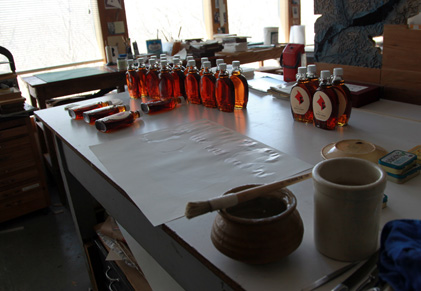
Meanwhile in the big woods spring’s sap flowed wildly, and this year’s supply of Archie’s Pure Maple Syrup is boiled, bottled, labeled, and available.
 From the time of my last post, until December 23rd, I printed. On December 27 I drove.